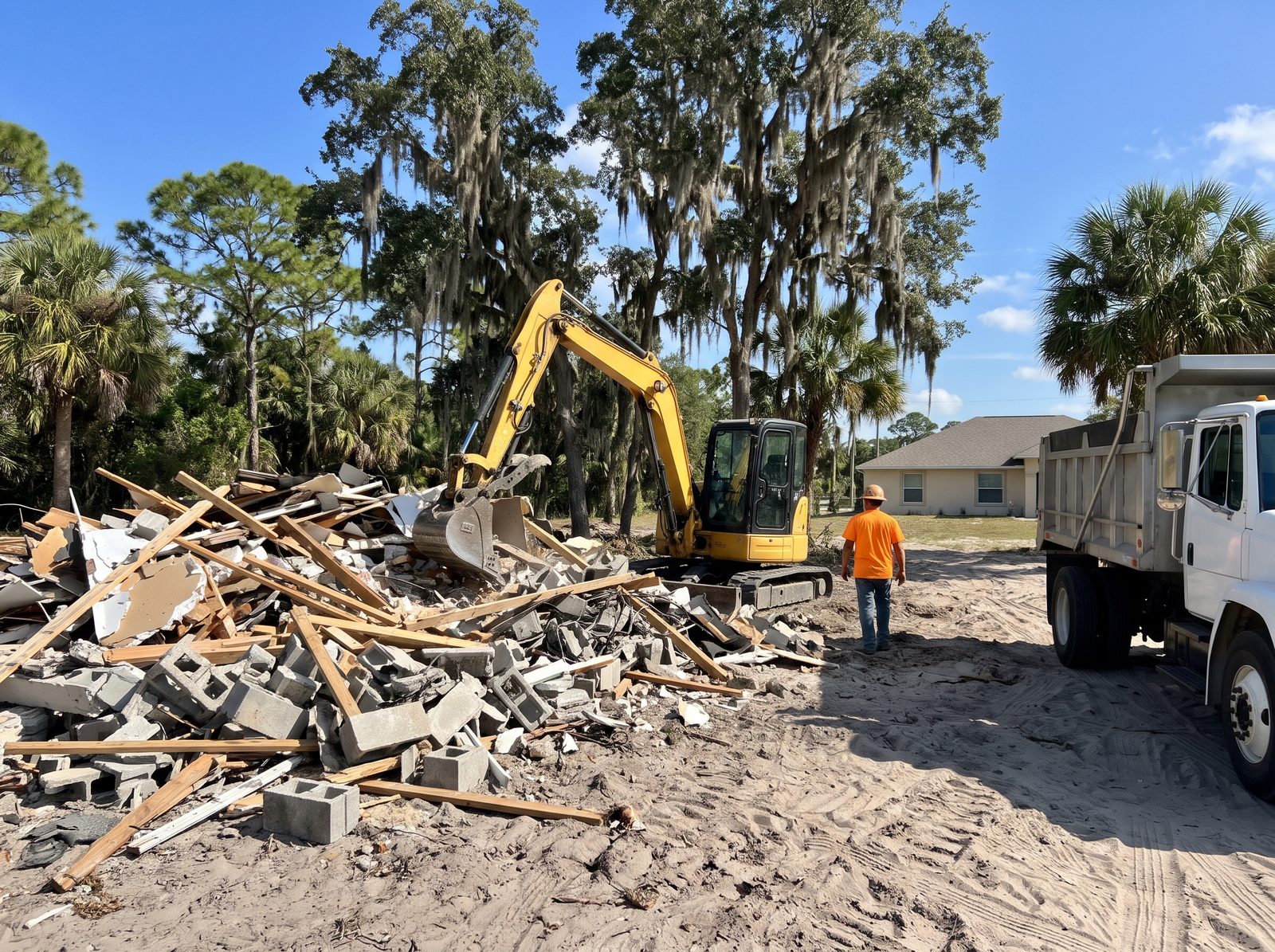
More Southwest Florida owners are tearing down rather than renovating, whether it is a flood-damaged home, an older house on a lot that is worth more empty, or a teardown bought to build new. The demolition itself is fast. What takes time is the order of operations before and after it. Miss a step, such as a utility that was never disconnected, and the whole schedule waits. Here is how a residential demolition typically runs, from the first visit to a lot ready for a builder.
Step 1: Walk the Property and Define the Scope
Everything else depends on a clear scope. On the walkthrough, the key questions are:
- Is the house concrete block, wood frame or a mix? What is the roof?
- What else is coming out: slab, footers, driveway, sidewalks, pool, pool deck, sheds, fences, septic tank?
- What stays: trees, a seawall or dock, a neighbor's fence, utility boxes?
- How will equipment and trucks get in, and are there overhead lines or tight setbacks?
The answers drive the price. For what moves that number, see demolition cost in Southwest Florida.
Step 2: Check for Asbestos
In older houses, asbestos may be hiding in flooring, textured ceilings, roofing, siding or pipe wrap. Florida's Department of Environmental Protection runs the state asbestos program. Its federal-based rules generally exempt residential buildings with four or fewer units, as long as they are not being demolished as part of a larger project and were never used as something other than a home. Larger residential buildings, commercial buildings and multi-home projects need an asbestos inspection and a written notice to DEP at least 10 working days before demolition, even if no asbestos is found.
Even for an exempt single-family home, your local building department may ask for asbestos information with the permit, and many owners order a survey anyway so there are no surprises. If asbestos is found, it should be removed by a qualified abatement contractor before teardown.
Step 3: Disconnect the Utilities
Each provider has to shut off and disconnect its service: electric, water, sewer, gas, cable and phone. Permit offices commonly want written proof of each disconnect before they will issue a demolition permit. Call early, since provider scheduling can take longer than the demolition. If the property is on septic, ask the permitting office how the tank must be handled; if it is on a private well, ask how the well should be dealt with.
Step 4: Pull the Demolition Permit
Each city and county in Southwest Florida issues its own demolition permits, and requirements vary. Expect to provide a site plan, owner authorization, utility disconnect confirmations and, where required, asbestos documentation. Lots in flood zones or along the water may have extra conditions. Your building department's website or permit desk will have the current checklist. If the lot will need clearing afterward, read our page on land clearing permits now so a second permit does not hold up the build.
Step 5: Call 811
Florida law requires notice to Sunshine 811 at least two full business days before any excavation or demolition, so member utilities can mark buried lines. Disconnected service lines are not the only thing in the ground; neighbors' lines and main utility lines may run along the property.
Step 6: Protect the Site and Set Up
Ahead of any demolition, the crew plans equipment access, a truck loading area and a staging spot for sorted debris. Trees, driveways, seawalls and neighboring property that are staying get protected. On a tight street, this is also when the truck route is planned so loaded dump trucks are not blocking neighbors all day.
Step 7: Bring the Structure Down
With an excavator, a typical single-family house usually comes down quickly, often within a day or two, depending on size and construction. Block homes with tie beams and thick slabs take more effort than frame houses, and a hydraulic breaker may be needed for heavy concrete. Materials are sorted as they come down: concrete and metal often go to recyclers, and the rest goes to a construction and demolition disposal site. Light water spray may be used to keep dust down.
Step 8: Remove the Slab, Footers and Buried Concrete
A builder will not start on top of an old slab, so the slab, footers, driveway, walkways and any buried concrete usually come out too. If there is a pool, it can be handled in the same visit; read full vs. partial pool removal to understand the options,.
Step 9: Haul Off the Debris
A whole house fills many dump-truck loads. Having the same crew demolish, load and haul keeps trucks moving and avoids renting and swapping dumpsters. We haul demolition debris by dump truck; see material hauling and delivery.
Step 10: Backfill, Grade and Leave the Lot Ready
With the house and foundation removed, the holes are backfilled with clean fill and compacted in layers, and the lot is rough graded so water drains properly. That leaves a clean, level site your builder can survey and start on. Some permits require a final inspection to close out the demolition. If the next step is a new home, our guide on getting a lot ready to build picks up from here, and grading and site prep can be done in the same mobilization.
How Long the Whole Process Takes
Plan for the paperwork to take longer than the work. Utility disconnects, any required asbestos steps and permit processing can take several weeks depending on the jurisdiction and the providers. Once the permit is issued, the teardown, slab removal, haul-off and backfill on a typical single-family lot often takes a few days to about a week, longer for large block homes, pools or bad weather.
Frequently Asked Questions
How many days does a house teardown take?
The teardown itself often takes a day or two for a typical single-family home. Including slab removal, haul-off and backfill, the field work usually runs a few days to about a week. Permits and utility disconnects beforehand can take several weeks.
Do I need a permit to demolish my house?
Yes, cities and counties in Southwest Florida require a demolition permit. Requirements vary, but they commonly include a site plan and proof of utility disconnects. Check with the building department that covers your address.
Do I have to notify the state before demolishing a house?
Florida DEP's asbestos rules generally exempt single residential buildings with four or fewer units that are not part of a larger project. Larger residential buildings, commercial buildings and multi-home projects need a notice at least 10 working days before demolition.
Will the slab and driveway be removed too?
They can be, and for a rebuild they usually need to be. Confirm that your quote's scope names the slab, footers, driveway and pool, if there is one.
Planning to tear down a house? Call or text 914-562-4457 or request a demolition quote. We will walk the property, explain each step and quote the full job, from teardown to a backfilled, graded lot.